

The amount of time I’ve wasted building half-baked things with LLMs is pretty staggering. I could have spent those hours improving my French, trying new recipes, or staring at the sky.
If I’m being kind to myself, I’d call it learning by doing. If I’m being less charitable, I’d say I was narrowly avoiding AI psychosis while burning through tokens like there was no tomorrow.
And I’m definitely not alone.
I’ve watched people in my orbit sink a breathtaking amount of time and tokens into workflows that get abandoned, deep research reports that nobody reads, and code left to gather dust in forgotten repos or Lovable apps.
The rise of AI-productivity theatre
If I want to waste my evenings in my terminal, at least that’s my prerogative. But when companies start doing the same thing at scale, it might help explain why nearly nine in ten executives report no gains from AI.
Part of this is easily explained. When people hear sweeping directives like “use AI”, they’ll find things to use AI on, whether or not those things actually need doing.

This is compounded by how organisations have spent the better part of a century measuring, monitoring and managing work (looking at you Taylorism). Somewhere along the way, producing evidence of productivity became the job.
AI threatens to take this to its absurd conclusion. It makes it easier than ever to churn out the things organisations run on—reports, presentations, dashboards, emails—without necessarily creating any more value.
And when the goal is to demonstrate that you’re using AI, the question shifts from “Does this need doing?” to “What can I produce to show I’m keeping up?”
The result is more output, but not necessarily progress.
The Solow productivity paradox, or a mirage?
There is, of course, a danger in dismissing all of this as pointless.
In 1987, economist Robert Solow observed that you could see computers everywhere except in the productivity statistics.
It took time for organisations to figure out how to use them effectively. And, critically, many of the benefits only materialised once businesses began changing how they worked.
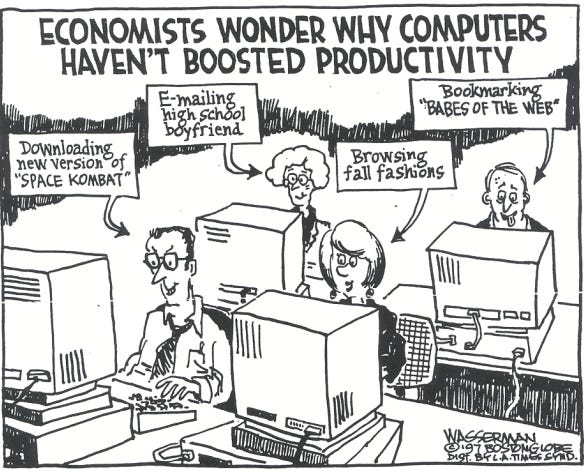
But there’s a difference between experimenting to discover what’s possible and using a new technology to reinvent things that already work perfectly well.
Consider an example in the WSJ from Retool CEO David Hsu, who described an employee at an unnamed company building an AI-powered out-of-office responder that ended up costing $10,000 a day.
Ignoring the absurd price tag, an out-of-office responder is something email clients have been doing perfectly well for decades. Someone found a way to spend an extraordinary amount of money automating something that was already largely automated.
That’s the problem with assuming AI’s productivity gains are simply taking time to materialise. Some investments will eventually pay off. Others are just expensive solutions in search of problems.
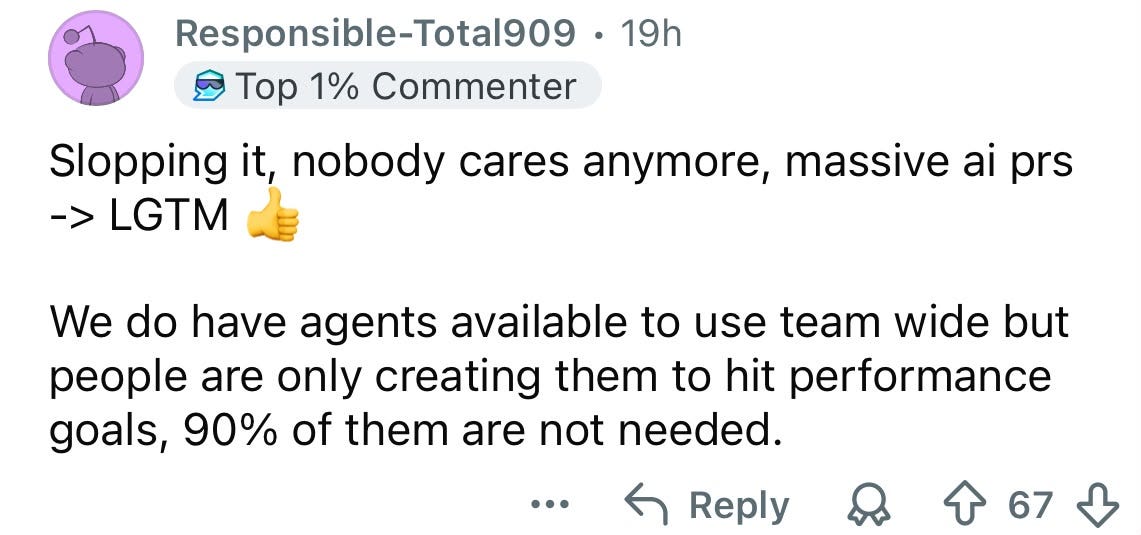
The choices we make may have less to do with the technology than with how organisations structure and incentivise their teams.1
So how do you avoid this?
The uncomfortable answer is that this probably isn’t an AI problem at all.
Most AI transformations focus on changing the tools and workflows while leaving the organisation around them untouched.
A generation of leaders raised on the big-consulting-firm school of managerialism — monitor, quantify and, above all, discipline the workforce — are now applying the same logic to AI.
So instead of using the technology to rethink work, they use it to measure more, automate more, standardise more and squeeze more output from the same structures.
It’s also why startups can look so much more radically AI-forward. Unshackled by layers of process, legacy incentives and organisational orthodoxy, they can redesign the work from first principles rather than bolting AI onto whatever was already there.
If the incentives, authority and definition of productivity stay the same, AI mostly gives people a faster way to reproduce the same problems.
1. Rethink the thing you’re doing entirely
About a year ago, I spent an entire weekend building a Webflow plugin to clean up CSS classes (if you know, you know) because it had become a mess.
Three months later, I’d rebuilt the entire website in a few evenings using Claude, Astro, Cloudflare and GitHub.
I’d spent a weekend making an existing (and very frustrating) workflow more efficient, only to realise shortly afterwards that I could rethink the whole thing from the ground up.
I see organisations make the same mistake with their tools and processes.
They’re so focused on finding ways to automate existing stuff that they rarely stop to question whether those tasks, processes or even the tools they’re using need to exist in the first place.2
1.1 Move authority closer to the work
The problem is that rethinking work is often at odds with how decisions are made as these decisions don’t always live at the individual contributor level.
A marketing analyst can produce a report but might not be authorised to discontinue it. A customer-service employee can identify a recurring problem but might not be able to change the process causing it. AI can make both employees considerably more efficient without making their work any more impactful.
It’s why you need to change what employees are empowered to decide. Instead of making the analyst responsible for delivering a weekly report, give them responsibility for improving the quality and timeliness of marketing decisions. Let them decide whether the report needs to exist at all.
That means giving people the authority to change the systems they work within, rather than making them more efficient at operating those systems.
Nothing about most companies encourages this behaviour and so many people don’t exhibit them.
This gap, both on a global and individual level, is really hard to solve because you can’t suddenly hand people alien technology and expect decades of organisational conditioning to disappear.
2. Make the incentives clear
Maybe you believe AI will usher in a permanent underclass and that the only rational response is to become AI-pilled and work 9-9-6. In that case, your incentives are pretty clear (though I’d argue your logic is dubious).
Otherwise, I think businesses have done a terrible job of explaining what’s in it for their employees.
If I discover that AI can automate half my job, why would I share that discovery if the reward might be twice as much work or my own redundancy?
Conversely, if demonstrating AI adoption protects my position, I have every reason to use AI for the sake of it, whether anybody needs the output or not.
AI-productivity theatre is a perfectly rational response to the incentives we’ve created.
Leaders need to explain what happens when AI makes work more efficient beyond increased profits.
Will the time saved be reinvested? Will employees gain more autonomy or share in the benefits? Will managers be rewarded for improving outcomes rather than simply cutting costs?3
There’s no single correct answer. But if you want employees to help rethink how work gets done, you need to give them a reason to believe they’ll benefit from doing so, rather than relying on fear (which is a very poor motivator).
3. Collaboration is the enemy
Well, not collaboration exactly.
There are people who genuinely seem to get energy from long Zoom calls, icebreakers, fireside chats and explaining basic concepts to stakeholders. I find most of this incredibly tedious and corny.
But the bigger problem is what happens when coordination becomes the work.4
Internal marketing. Alignment meetings. Stakeholder updates. Approval chains. Making sure Bob in product feels consulted before you change something that barely affects Bob in product.
All of these things can be individually reasonable. Collectively, they waste an enormous amount of time.
And AI makes the contrast more obvious.
The cost of producing something is collapsing, while the cost of getting six people to agree on it remains stubbornly human.
Worse, you can’t build reliable systems around a constantly changing stream of opinions, exceptions and “quick thoughts.” Automation needs reasonably clear inputs, decision rights and definitions of success.
Maybe, just maybe, in a brutally competitive market, more of our working hours should be spent figuring out how to win externally and fewer spent proving internally that we know what we’re doing.
If your most important audience is the rest of the company, it probably shouldn’t surprise us when an AI transformation produces more internal theatre rather than actual customer value.
AI productivity gains don’t start with AI
Realising AI’s potential might require something rather more uncomfortable than giving everyone tokens.
The problem is that the things that actually matter are also the hardest things to change.
Buying software is easy. Rethinking who gets to make decisions, how managers are rewarded, which processes should disappear, and what happens to the time AI saves is much harder.
And organisations, like people, tend to reach for the visible, easy thing first.
But without them, there’s a risk that AI simply makes us extraordinarily efficient at perpetuating the bureaucracy we’ve spent the last century building.
Is AI a poetic technology or a bureaucratic technology? I really like the way David Graeber laid it out here when talking about innovation more generally. I don’t think we spend enough time talking about this.
“If I had asked people what they wanted, they would have said faster horses.”
I don’t think corporate leaders realise just how deeply cynical the last 5ish years have made people about work. Ham-fisted corporate AI initiatives are the latest nail in the coffin. A tired, distrustful workforce won’t deliver much innovation.
PostHog said it best when they said collaboration sucks.