

Will slop be the word of 2026? First there was LinkedIn’s accusatory button. Then there was the news that Claude is watermarking content. All this caused a lot of consternation, glee, and a painful volume of “I told you so” LinkedIn takes.
What the broader reaction tells me is that the penny hasn’t dropped for the vast majority of folks and that people need to go read Ryan Law’s article from 2021, “You’re a Content Marketer, Not a Writer.”
The discourse has been obsessing over em dashes, tell-tale sentence structures, and an LLM’s tendency to create whacky and awkward analogies. I get it! It’s fun to dunk on super lazy AI copy.
But my view is that the obsession with copy assumes that people are hanging on every word of your blog, report, or FAQ. I don’t believe that’s the case for a myriad of reasons, but mostly because the way many of us consume information is undergoing a radical shift.
Put in very simple terms: I spend a chunk of my day interfacing with LLMs and while I chuckle at their AI-isms, I don’t really care about their phrasing because I’m (mostly) getting tons of value when it comes to doing things.
So the question is does your content provide value beyond what someone could get from interfacing with ChatGPT. If I want to read beautiful, human-constructed prose I have a stack of novels that I’ve been meaning to get through (currently reading Flights by Olga Tokarczuk which I can’t recommend enough).
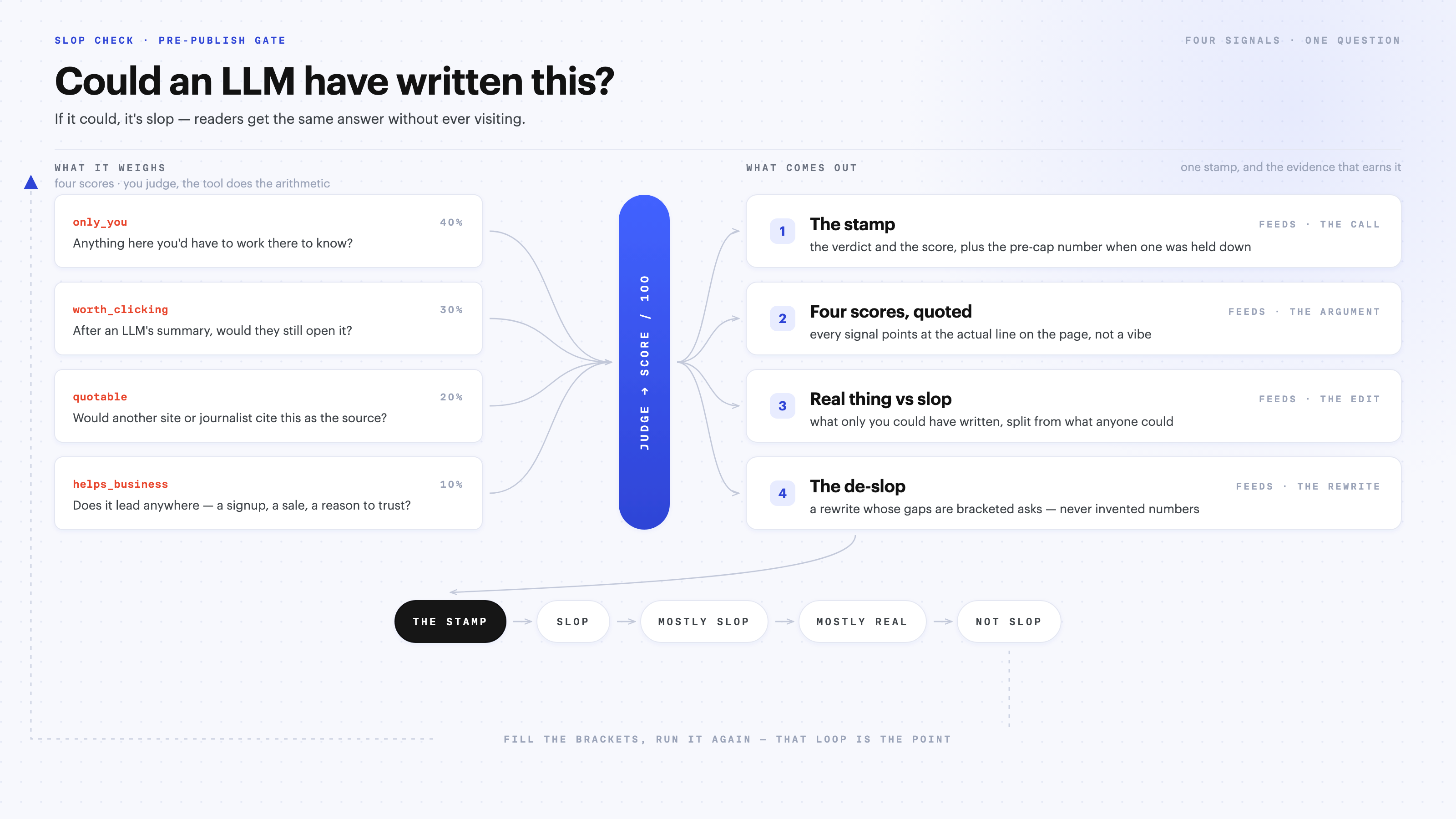
Anyway I built a way to check your content for you. Paste a link, it reads the page and answers one question: could an LLM have written this?
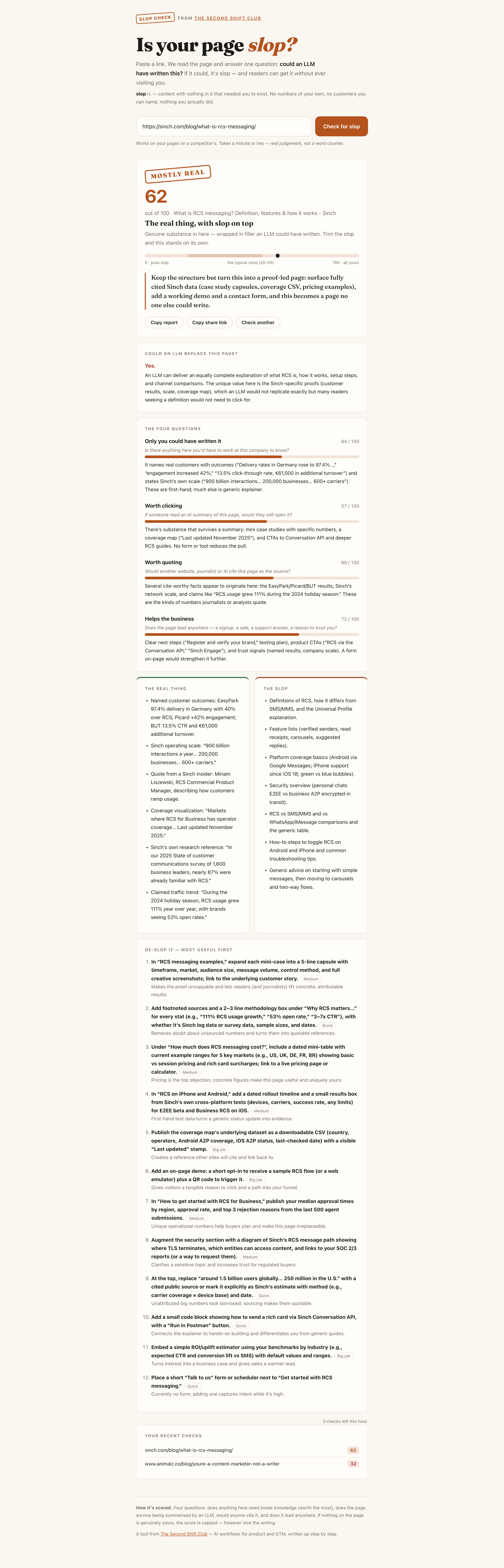
And here are the results for a page I recently refreshed. (Most of the value, IMO, comes from the suggestions on how to de-slopify it.)
I have also included a separate skill if you want to run this as part of a broader workflow in a new Github repo: https://github.com/secondshiftclub/workflows/. It includes past workflows from previous editions of this newsletter. Have at it!