

Keyword tools tend to tell you what people type into Google. Reddit tells you what they actually say. Instead of spamming Reddit with inauthentic brand mentions, you can use the platform’s posts/comments as a really great (and relatively simple) way to improve AI-generated copy.
Step 1: Find the right subreddits
Two questions get you to better sources:
Where does your buyer hang out for reasons unrelated to your product? If you sell to restaurant owners, r/restaurantowners will outperform any software subreddit. People tend to be more honest when it’s peer-to-peer.
Where do people go to complain about the job your product does? The frustration is the raw material.
Practical ways to find them:
Google site:reddit.com “your problem in plain words” and note which subreddits keep appearing
Open three or four posts you like and check what else those commenters post in
Search Reddit for a competitor’s name and see where it comes up
Step 2: Pull the data
Don’t scrape, and don’t rely on Reddit’s own search. Reddit’s search caps out at roughly 1,000 results with no way past it, so anything beyond the most recent slice is invisible. Third-party scrapers hit the same wall.
Use an archive instead. Arctic Shift has the full history, stays current to about yesterday, and has a browser tool that requires nothing technical:
Type the subreddit name (no r/)
Choose posts and comments
Set a date range; the last three to six months is a good first pass
Download, then open the file in Google Sheets or Excel
That’s the whole thing. If you’d rather not click through it, any AI assistant with web or code access can do this for you. Just describe what you want:
“Pull posts from r/restaurantowners over the last six months that mention PoS, and pull out the recurring complaints.”
There’s an appendix at the bottom with the API details if you or someone on your team wants to automate repeat pulls.
Step 3: Read it properly
Feeding the file to an AI assistant works well. Ask for recurring themes, common objections, and the phrases that appear most.
Step 4: Incorporate it into workflows
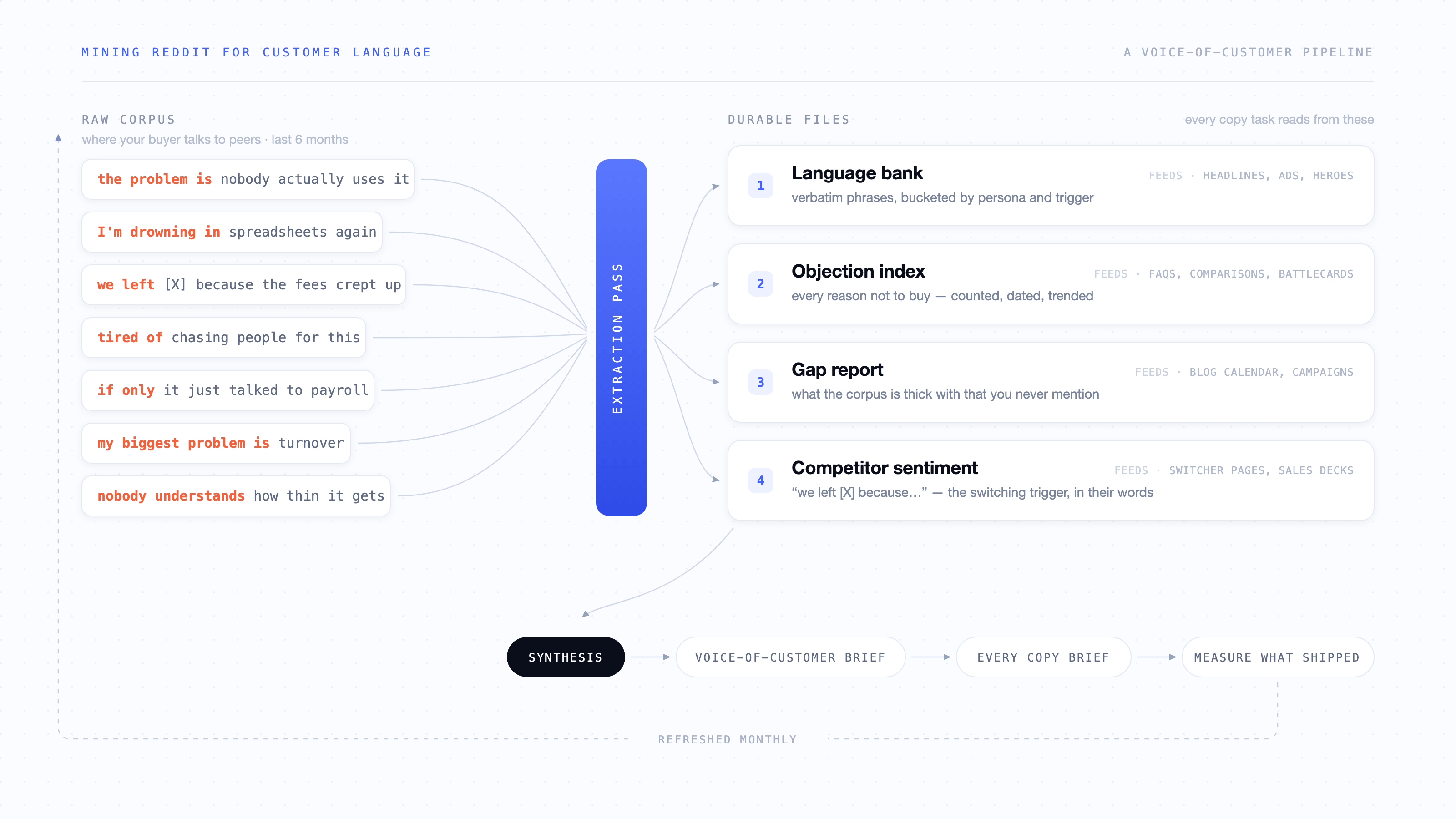
The next step is to turn this into a small set of durable files that every copy task reads from, refreshed on a schedule.
1. The language bank
Verbatim phrases, bucketed by who said it and what set them off.
Don’t cluster by topic. Grep for the grammatical markers of unmet need: “I wish,” “if only,” “I’m drowning in,” “tired of,” “the problem is,” “my biggest problem,” “nobody understands.”
Bucket by persona first. “The schedule is a mess” is a labour-cost problem from an owner, a workload problem from a GM, a fairness problem from a server. One bucket each, or it averages into mush.
Feeds: Headlines, ad copy, hero sections, subject lines. You stop writing copy and start selecting it.
2. The objection index
Every reason people give for not buying something like yours, counted and dated.
Store the count, the average score, the best quotes, and the trend. Restaurants: the staff won’t use it. The processing fees eat whatever you saved on hardware. Menu setup took three weeks. Now I’ve got the tablets and the paper tickets.
The trend is the point. An objection that’s growing earns a section on the page. One that’s shrinking is a solved category problem (answer it and you sound dated).
Feeds: FAQs, objection blocks, comparison pages, battlecards.
3. The gap report
Your messaging, audited against the corpus. What you claim that the data backs and what the data is full of that you never mention.
The gaps are the half worth having, and they’re rarely about your product. A restaurant corpus is thick with anxiety about staff turnover, food costs, delivery-app commissions, and one bad Google review. None of it is a PoS feature. All of it is what your buyer is chewing on the day they hit your page.
Feeds: The blog calendar, top-of-funnel, campaign themes.
4. Competitor sentiment
Not share of voice. Specific failure modes.
“We left [X] because…” is the most valuable sentence in the corpus, and there are hundreds of them. It hands you the switching trigger, the breaking point, and the exact words a switcher uses to justify the move, which is the copy that converts the next one.
Feeds: Comparison pages, switcher campaigns, sales decks.
RAW CORPUS
  posts + comments, refreshed monthly
      |
      v
EXTRACTION PASS
  segment by persona, then
  match on trigger phrases
      |
      +--> LANGUAGE BANK
      +--> OBJECTION INDEX
      +--> GAP REPORT
      +--> COMPETITOR SENTIMENT
      |
      v
SYNTHESIS
  ranked priority list
  voice-of-customer brief
      |
      v
EVERY COPY BRIEF
  pages, ads, blog, decks
      |
      v
MEASURE WHAT SHIPPED
      |
      +--> feeds the next refresh
Important caveats
It supplements customer conversations, it doesn’t replace them
Reddit skews younger, more US, more English-speaking, more technically inclined.
Competitors and their agencies post too. “We switched to X and never looked back” is often marketing.
A growing share of Reddit text is bot output, karma farming, and reposted old threads.
People post when something hurts. Status, ambition, and identity motives — often the real reason for a purchase — are nearly invisible in a complaint corpus.
Appendix: Automating the pull
Arctic Shift has a public API for repeatable pulls:
https://arctic-shift.photon-reddit.com/api/posts/search
  ?subreddit=<name>
  &after=<unix-timestamp>&before=<unix-timestamp>
  &sort=asc&limit=100
  &fields=id,created_utc,author,title,selftext,score,num_comments,link_flair_text
Swap /posts/ for /comments/ to pull comments. Notes for whoever wires it up:
Paginate by setting after to the last item’s created_utc and deduping on id. Bump forward a second when a batch shares a timestamp, or the loop stalls.
permalink is not a valid field — requesting it returns a 400 that kills the whole call. Rebuild links as reddit.com/r/<sub>/comments/<id>/.
query=<terms> does full-text filtering and ANDs the terms — the fastest way to cut a huge subreddit down to relevant posts.
Be polite: a short pause between requests and a real User-Agent string.
Once you’re past a few hundred thousand rows, load the corpus into SQLite rather than re-parsing files. Extraction passes become queries, monthly refreshes become an insert, and the whole thing still fits on a laptop.