

I have a confession to make: for a while, when I was Director of Marketing at SimpleTexting, our positioning was the “all-in-one texting platform.”
It was very much of its era. We were heavily focused on dominating the SERPs and delighting customers; we could probably have called ourselves “Mickey Mouse’s preferred texting tool” without doing much damage to growth.
Businesses found us because they wanted to text. We often showed up first, we were affordable, the product was solid, and it was easy to get started.
In a world in which a 17-year-old in their parents’ basement can vibe code your product in a weekend, I am not nearly so relaxed about positioning.
It’s probably one of the most important things a business can get right, and also one of the hardest because you only know if you got it right ex post.
To help you I’ve spent time testing how AI engines recommend products. Here are a few thoughts on what to do, and what not to do.
Methodology
Before you come at me, this is not a rigorous research project and there are flaws, lurking variables, and other concepts I learned in Econometrics that I vaguely remember.
Everything here comes from three small studies I ran, with about 1,100 controlled answers, cross-checked against a month of real tracked answers for a group of brands I monitor.
I’m also aware that:
I used an API model with no product memory or personalization
It’s one model family (gpt-5.2), one day, US English
Like many things in the world of AEO it is directionally interesting, but I’m not presenting it as gospel.
(If you’re interested in sponsoring a larger, more rigorous study, do come at me. 😉)
A quick word on positioning
I’ve done my fair share of positioning workshops over the years but I don’t pretend to be an expert’s expert. I have one particular observation that is important for the AI era.
Positioning work tends to fail because it is inherently about tradeoffs and companies (especially software companies) are reluctant to close doors that might lead to future revenue.
The latter is particularly problematic because LLMs will force these tradeoffs on you, and they may be sub-optimal.
So if I were parachuted into a positioning workshop I’d still ask everyone to:
Pick a category buyers already recognize
Name the alternatives inside it
Say what makes then different
Say who it's for
That much hasn’t changed.
The problem is that LLMs make positioning incredibly sticky and hard to pivot. That's hard on a startup still hunting for traction, and on an established business trying to reposition itself.
Lesson 1: Categories > jobs-to-be-done
My hunch is that buyers using LLMs talk less in categories and more in jobs (some data supports this thesis).
It makes sense to me that somebody opening ChatGPT is less likely to type “best digital adoption platform.” Instead you’d expect them to type: “half the people who sign up for my product never come back after day one…what should I use to fix it?”
It might be tempting then to recommend leaning on jobs-to-be-done positioning where you market to the job the buyer is trying to get done rather than the category they’d shop in.
To test this I ran matched pairs: the same buying question phrased as the category versus the job.
What I learned is that the AI doesn’t answer the job question directly. In 92% of answers it searched for the nearest category, then recommended those brands.
Take hiring. It’s a gerund market. Hiring, recruiting, screening, interviewing, sourcing, onboarding. These are things people do, and not things people buy.
So when someone asks ChatGPT for candidate screening tools, it doesn’t search for that. It takes the verb, guesses which nouns the verb usually lives inside, and goes looking for those.
Then it opens the answer with “if by candidate screening you mean...” and builds a table with an ATS row, an assessment row, an engineering-tests row. Every brand in the table is heavily associated with one of those category nouns.
Takeaway
Ask the engines your buyers’ actual questions, job wording and all, and watch which category nouns the answers land on. Those lists represent your real competitors.
Win a spot in one of them, then keep writing for the jobs; job pages get quoted in answers, but only the category gets you recommended as an option.
Lesson 2: Changing categories is really hard
Chug enough coffee and burn enough Claude tokens and you will eventually think I should just create a new category.
I looked at twelve well-known companies that rebranded into new, broader categories over the past few years. Intercom is now “the AI customer service company.” Klaviyo is a “B2C CRM.” Airtable builds “AI apps.”
I pulled LLMs’ descriptions of all twelve. Across 72 answers, the new category appeared without the old one exactly twice.
Intercom got called live chat software six times out of six. Klaviyo is still email marketing. Airtable is still a spreadsheet-database.
The reason is simple. The AI’s memory was built from years of everyone else’s writing. “Intercom does live chat” is a thousand pages across many years.
It’s really, really hard to reorient LLMs.
Takeaway
Ask the engines “what is [your company]?” The phrase in their answer is your real category, not whatever your internal decks say. Dominate that one first.
And if you’re set on inventing a category or changing your existing category, be honest about the job: it isn’t just an update to your homepage, it’s getting thousands of other people’s pages to repeat it. Budget years and bucketloads of cash.
Lesson 3: The fastest-growing categories are people-shaped
You can always latch onto rapidly growing categories.
I checked 2,302 Y Combinator one-liners across a decade of batches from 2015. What exploded in recent years is positioning as a role: AI SDR, AI recruiter, and AI engineer went from 1% to 20%, almost all since 2023.
And buyers followed. “AI SDR” went from ~12 searches a month in 2022 to ~2,400 now, sixteen times the volume of “SDR tools.” These phrases became categories in about eighteen months.
While people might roll their eyes at AI in every H1, there is meaningful demand for these categories.
Notice what they have in common with the categories that held up in Lesson 1. They’re nouns. A role is a thing you can hire, so an LLM can put it in a table without translating it into something else.
Takeaway
New categories can be minted fast these days when the internet writes about them in unison. It’s easier to spot a trend than to create one.
The four states of a phrase
All this means the question you need is to answer is what state is your category phrase in (as far as the engines are concerned). Here’s how I think about it:
Shelf. The engines answer in this noun without translating it. The table exists, the rows are taken, and the only move is a cell inside it: a segment, a price point, a mechanism nobody else has. This is most established categories.
Forming. The phrase is in circulation, the engines use it as a modifier or a “best for” label, but no brand owns it as a category yet. This is where the people-shaped categories were in 2023. It’s the cheapest shelf to claim, and the window is short.
No shelf. The engines rewrite the phrase into another noun before answering. The first-sentence test fails. You can rank for it on Google and still never be named. Most gerunds live here.
Held. A niche you already win: a specific prompt or segment where the engines name you consistently. Small, but it’s proof the mechanism works, and it’s the corner you expand from.
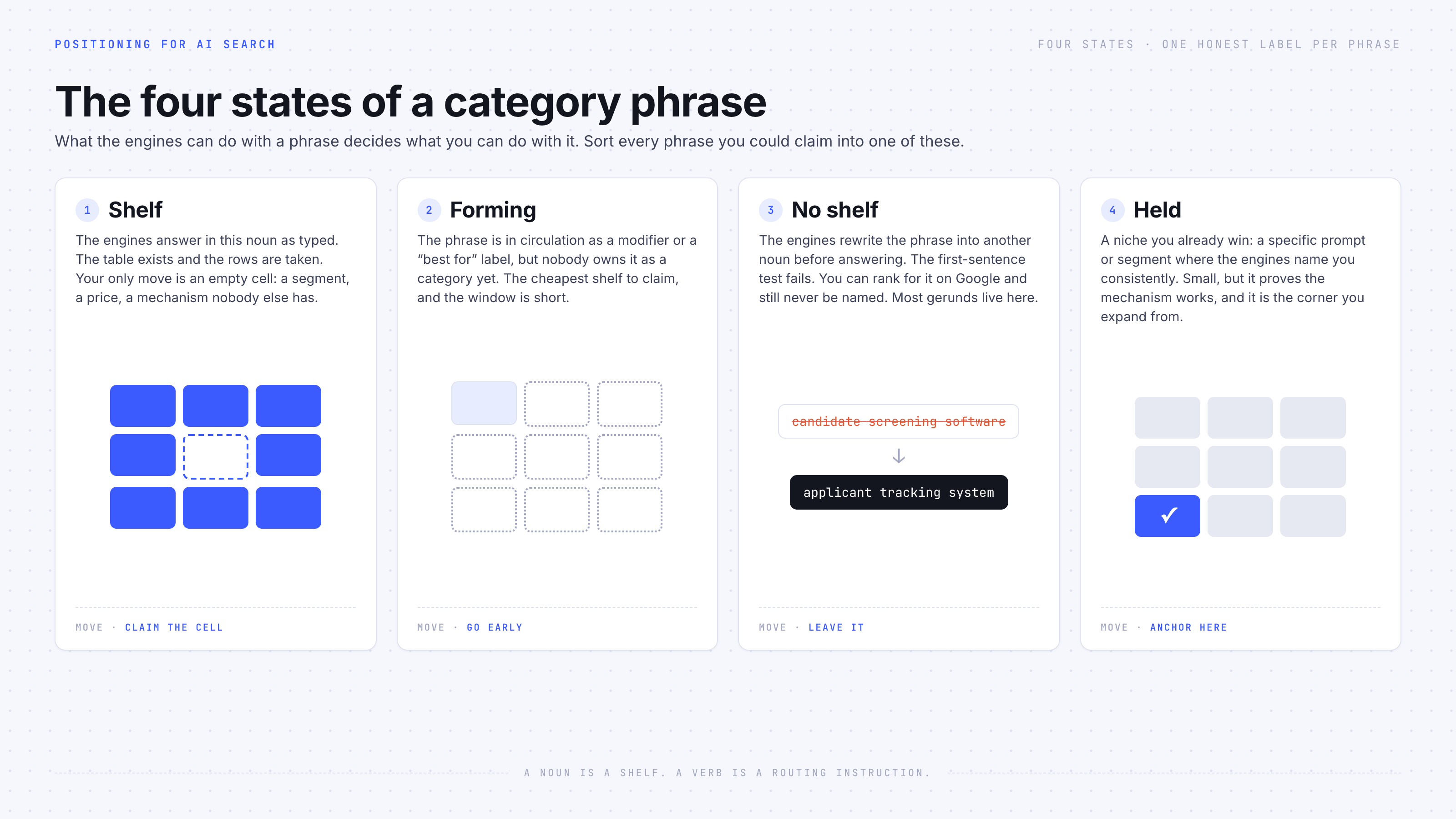
Run the tests from Lessons 1 and 2, sort your candidate phrases into those four states, and the decision mostly makes itself. Take the held niche as the anchor.
The goal is to claim the empty cell on a shelf, or move early onto a forming noun. Never stand on a no-shelf phrase and wait for a table to appear.
If you move at all, move with a current, not against one. When the whole internet starts repeating a phrase at once, a category is created in months and the earliest names get glued to it.
The tells: search demand rising, other people’s pages using the phrase, and, ideally, a phrase your name already plausibly sits next to.